
Neighborhood History
History
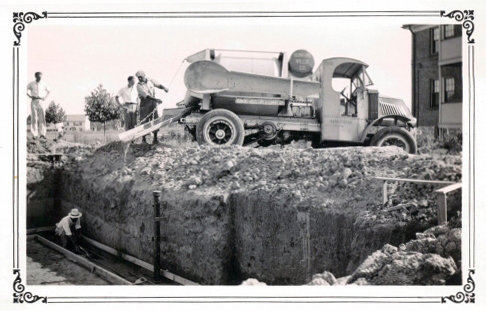
St. Louis Hills is rich in its architecture, strategic location, and its history. “Country living in the City” was the phrase used to market St. Louis Hills in the 1930’s, since St. Louis Hills was so far west of any other residential or commercial buildings located within the City limits.
Some 90 years later, the rich history and tradition of St. Louis Hills lives on, and the St. Louis Hills Neighborhood Association is formally trying to improve its historical focus on what is considered by many to be the most desirable neighborhood in the City of St. Louis.
Read More St. Louis Hills History
The history of St. Louis Hills, developed from 1930-1950’s, is relatively short by the city’s beginnings in 1763. The land which became St. Louis Hills dates back to deeds granted to pioneer French colonists Madame Ann Camp and Anton Reihle in 1768 by one founder of the Village of St. Louis, Pierre Laclede. At the time, the land included 2,471 acres. Camp and Reihl’s heirs sold the land to George C. Clarke, who gave it to two sons. When the Village was chartered as the City of St. Louis in 1836, St. Louis Hills was still remote, open and forested land, and essentially remained so until the early 1930’s. In 1876, when the county and city of St. Louis divided responsibilities, the western boundary of St. Louis City was set just west of the River des Peres (River of the Fathers). Even then, what is now St. Louis Hills, was still open land.
David Rowland Francis, Governor of the state from 1889-1893, became owner of part of the property in 1884 on which he established his vast farm. At the turn of the century, David R. Francis was President of the Louisiana Purchase Exposition from 1889 until its opening in 1904. Francis originally considered use of his farmland as a site for the World’s Fair, but logistics of transportation and construction to Francis’ land persuaded use of Forest Park as the now famous 1904 World’s Fair site. Francis was appointed U.S. Ambassador to Russia in 1916. The next year, Francis made a gift of the land to the city, and so it was named Francis Park. David Rowland Francis died January 15, 1927.
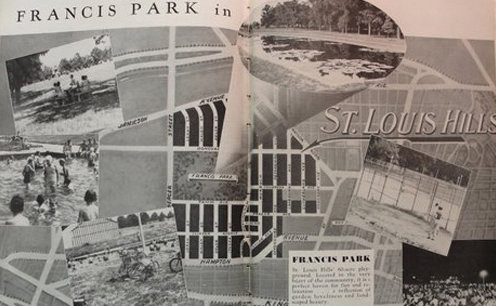
Cyrus Crane Willmore, for whom the neighborhood’s second park is named, became the visionary developer of the St. Louis Hills 700 acre neighborhood. He came to St. Louis in 1912 after graduation from the University of Illinois law school, and worked for a realty firm until 1922 when he formed his own company. Willmore’s intentions for the area were clear from the beginning: tree lined residential streets for families and single persons, churches and schools throughout, bordered on three sides by developing businesses, and open green spaces in parks. (See Architecture and Parks for more information.)
Names of streets within the neighborhood, as well as early development architecture, reflect Willmore’s English heritage—Nottingham Avenue, Devonshire Avenue, Tamm Avenue to name a few. Eichelberger Street, a main east-west roadway through the center of St. Louis Hills, was originally named Clarke Road for George C. Clarke. Mature trees lining streets throughout the area are predominantly oak, maple, poplar, with birch trees along Francis Park.
Got History?
If you or someone you know has in their possession any Hills historical documents or artifacts, please contact Nancy Vordtriede at (314) 616-6468. Donors will be permanently acknowledged for their donations.
SLHNA History Committee – Ted Drewes Interview
This interview was done by Ron Elz (aka as Johnny Rabbitt), a long-time and famous resident of St. Louis Hills. The interview was conducted in early 2015.
The Johnny Rabbitt Interview
Johnny Rabbitt (aka Ron Elz) introduced the Beatles to a sold-out crowd at Cow Palace in San Francisco in 1964. His career has been amazing, as featured in this interview.
Historical Publications (Originals)
The SLHNA History Committee is seeking contributions for the St. Louis Hills archives.
Any historical publications or artifacts would be most welcomed, and would be under the ownership and control of the Association. All donors will be permanently recognized for their contributions.
Click here to see all donations and donors.
History Committee
The SLHNA History Committee is dedicated to preserving the history of St. Louis Hills. This includes collecting and retaining any and all historical artifacts, documents and magazines. For example, the Committee possesses ninety-one original News of St. Louis Hills magazines dating from 1930 to 1952.
The Committee has also interviewed two of St. Louis Hills most famous people, Ted Drewes and Johnny Rabbitt. Both interviews are on the SLHNA website.
For additional information, or if you have any questions, please contact Rick Palank, 314.309.4044, rpalank@gmail.com.
Below is a list of the historical publications donated to the Association. The donor is recognized in parentheses.